
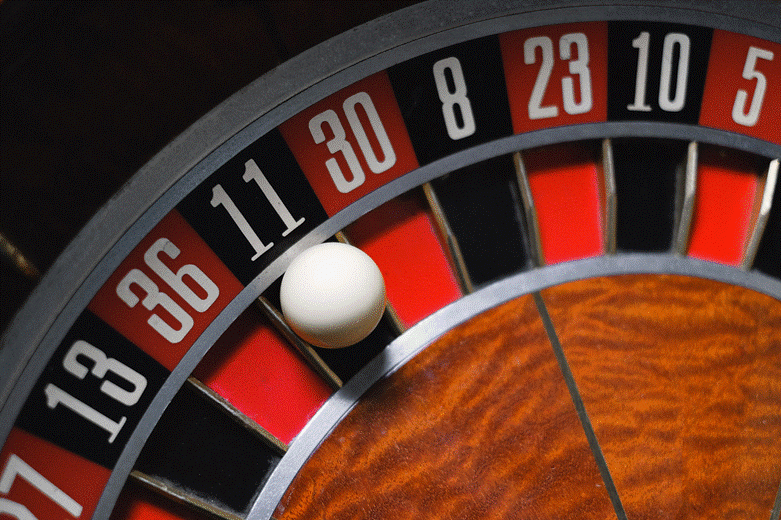
Roulette has survived just about every change the casino business has thrown at it. Slots went digital, blackjack picked up endless side bets, and whole casino floors moved onto phones. Roulette? There’s still a wheel, a ball, and someone hoping it lands on 17.
That’s probably part of why the game travels so well. You can walk into a casino in Europe, open a live table in the U.S., or watch a game streamed from a studio somewhere else and understand what’s happening pretty quickly. The details change. The basic idea barely does.
You Can Understand a Spin in About 30 Seconds
Roulette doesn’t ask much from a new player.
Pick red or black, and you already understand one of the main bets. Put a chip directly on a number, and you’ve made another. The dealer spins the wheel, the ball lands, and the winning bets get paid.
There’s more to learn if you want it. Splits, corners, dozens, columns, and wheel sectors give regular players plenty to play around with. But none of that is required just to follow a round.
That’s a big advantage for a casino game. Blackjack has decisions to make during a hand. Poker takes much longer to learn properly. Roulette lets somebody join a table without feeling completely lost.
The Wheel Gives You Plenty of Ways to Bet
Roulette has a nice trick: the game stays simple even though the betting layout isn’t.
A player can put everything on one number, cover half the numbered wheel with red or black, or land somewhere between those two extremes. The bets feel very different even though they’re all attached to the same spin.
|
Bet |
Numbers covered |
Standard payout |
|
Straight-up |
1 |
35:1 |
|
Split |
2 |
17:1 |
|
Corner |
4 |
8:1 |
|
Dozen |
12 |
2:1 |
|
Red / Black |
18 |
1:1 |
That gives roulette some variety without asking people to learn a new game every time they want to change things up.
Live Roulette Brought Back What Early Online Games Lost
The first digital roulette games could copy the rules perfectly, but they couldn’t really copy the table. You clicked a bet, watched an animated wheel, and got a result. It worked, but it felt more like software than a night at a casino.
Live roulette changed that.
Now there’s a real dealer on camera and a real wheel being spun somewhere on the other side of the stream. The chips are digital, but much of the old table experience is back.
The live games at www.roulette77.us/live-roulette show how little roulette really needed to change for streaming. Roulette 77 covers different table formats, but the main event is still the same: the wheel spins and everyone waits for the ball to drop.
That’s one reason roulette adapted so comfortably to live casino. It already had something worth putting on camera.
There’s a Version for Different Parts of the World
Roulette isn’t exactly the same everywhere.
European roulette uses 37 pockets, with a single 0. American roulette adds 00 for 38. French roulette uses the single-zero wheel but can add rules such as La Partage or En Prison.
Those differences matter. Standard European roulette has a 2.70% house edge, while the usual American game comes in at 5.26%.
But from a player’s point of view, they’re still obviously roulette. Red is red, a straight-up number still pays 35:1, and the wheel is instantly recognizable.
That has made the game easy to carry from one casino market to another without turning it into something completely different.
There’s Something About Watching the Ball
This part gets lost when roulette is reduced to a probability table.
The result doesn’t simply pop onto the screen. The ball has to get there.
It circles the wheel, slows down, starts bouncing between pockets, and sometimes looks settled before jumping somewhere else. A bet can be dead in a second or look alive until the final bounce.
That little bit of waiting matters. It’s why watching a roulette spin feels different from pressing a button and seeing three slot reels stop.
Live casino studios have leaned heavily into that visual side of the game, with roulette now offered in standard, speed, automated, and more elaborate live formats.
The technology around the wheel keeps changing because the wheel itself is already good television.
Everybody Has a Number
Ask people for a roulette number, and you’ll hear plenty of reasons that have nothing to do with probability.
Some pick a birthday. Others have always liked 7. Somebody once won on 23, and now 23 gets another chip every time they see a wheel.
None of those stories changes the odds. Every individual pocket on a fair wheel has the same chance as every other individual pocket.
But roulette gives people room to make those choices anyway. You aren’t dealt a number. You pick it yourself.
A few of the usual choices are easy to recognize:
● birthdays and anniversaries;
● traditionally “lucky” numbers;
● a number that won for the player before.
The math doesn’t care about any of them. The player usually does.
A Roulette Table Can Be Social Without Requiring a Team
Poker players are directly competing with each other. Roulette players aren’t.
Ten people can stand around the same wheel and make completely different bets. One can win while another loses, but neither caused the other’s result.
That makes roulette a pretty easy social casino game. People watch the same ball, react to the same strange streaks, and sometimes pile onto the same number, but everyone still has their own chips on the layout.
Live roulette kept some of that online. Chat isn’t the same as standing beside a table in a casino, obviously, but having a dealer and other players around makes the game feel less solitary than a standard RNG screen.
The Wheel Still Works
Roulette doesn’t need much reinvention. That’s probably its best trick.
The game is easy enough for somebody to understand on a first visit to a casino, but there are enough bets and versions to keep it from feeling completely one-note. And when casinos moved online, roulette happened to be perfect for live video: people actually want to watch the wheel spin.
After a couple of centuries, the setting has changed far more than the game. A roulette player from decades ago would probably be confused by the phone, the livestream, and the digital chips. The wheel wouldn’t need much explaining.