
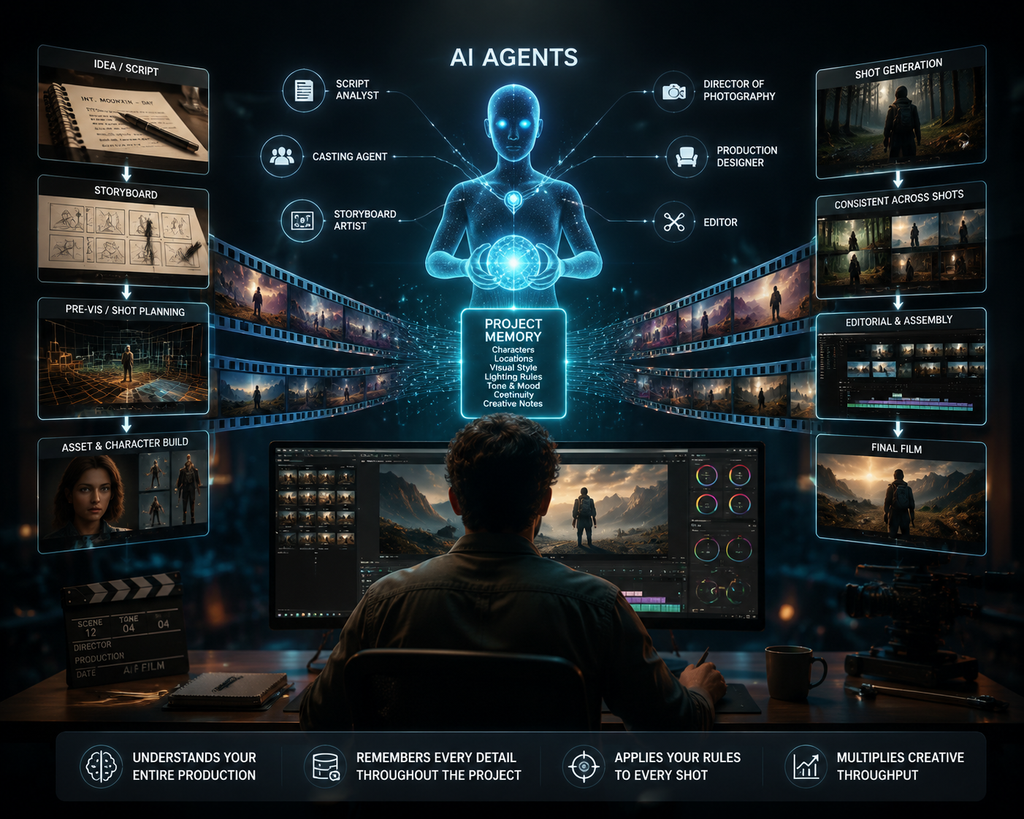
Filmmaking has always been a balance between creative vision and practical execution. A director may have a clear idea for a scene, but turning that idea into a finished sequence requires writers, cinematographers, editors, designers, sound teams, and many other specialists. For independent creators and smaller production teams, managing every part of that process can be challenging.
The rise of AI is changing how filmmakers approach production. According to a Wikipedia report on the growth of artificial intelligence applications, AI adoption has expanded rapidly across creative and business fields, with organizations increasingly exploring AI tools to improve productivity and workflows. Artificial intelligence overview on Wikipedia
AI Filmmaking is not about replacing the creative decisions behind a film. Instead, it is creating new ways for filmmakers to plan stories, visualize scenes, maintain continuity, and handle repetitive production tasks. The biggest shift is moving from isolated AI tools that create individual clips toward systems that understand an entire project.
Modern AI video workflows can now support everything from early story development and pre-visualization to editing and finishing. The goal is simple: help creators spend more time making creative choices and less time managing production complexity.
How does AI Filmmaking change production?
AI Filmmaking changes production by turning many technical tasks into collaborative workflows. Instead of treating AI as a simple generation tool, filmmakers can use it as a creative assistant that understands story structure, visual direction, and production requirements.
The traditional filmmaking process often moves through separate stages:
- Writing and refining the story
- Planning shots and camera movements
- Creating visual references
- Organizing characters and locations
- Recording or generating footage
- Editing and polishing the final cut
AI connects these stages by allowing information from one part of production to influence another. A character designed during development can remain consistent during later scenes. A visual style selected during planning can guide future shots.
This project-level understanding is one of the biggest developments in AI Filmmaking because consistency has always been one of the hardest challenges in digital production.
What problems does AI solve for filmmakers?
Many filmmakers struggle with maintaining creative consistency across long projects. A character may change appearance between scenes, locations may lose visual identity, or camera choices may feel disconnected after multiple production steps.
AI helps address these challenges through better project memory and reference management.
Some important areas where AI supports filmmakers include:
- Story development: AI can help organize ideas into scenes, acts, and narrative structures.
- Pre-production planning: Creators can build storyboards, shot lists, and visual plans before production begins.
- Character consistency: AI systems can maintain character details across different scenes.
- Visual continuity: Locations, lighting approaches, and creative rules can remain consistent throughout a project.
- Editing support: AI can help assemble footage, create variations, and speed up review processes.
A major advantage of AI Filmmaking is that it allows creators to explore more possibilities before committing resources. A filmmaker can test different approaches, compare scene versions, and make stronger creative decisions earlier in the process.
How do AI agents support filmmaking workflows?
AI agents represent a different approach from traditional creative software. Instead of asking users to manage every individual instruction, AI agents can understand a broader objective and assist across multiple production steps.
Invideo Agent works as an AI filmmaking collaborator that helps filmmakers move from an initial idea to a complete production process. A creator can provide a script, treatment, or concept, and the agent can help break down the story, plan scenes, develop characters, create boards, and generate shots based on the director’s guidance.
The key difference is that the filmmaker remains in control. The AI handles supporting tasks, but creative decisions still come from the director. This approach allows creators to focus on storytelling rather than repeating technical instructions.
A complete AI filmmaking workflow can include development, planning, generation, and editing in a connected process. You can explore this approach through the AI filmmaking workflow by invideo Agent, which shows how AI-assisted production can support different stages of creating a film.
The workflow becomes especially useful for projects that require many connected scenes. Instead of treating every shot as a separate request, an AI agent can remember project details and apply them throughout production.
How does AI maintain film continuity?
Continuity is one of the most important parts of filmmaking. Small differences between scenes can affect how audiences experience a story. Traditional productions solve this through detailed notes, continuity supervisors, and careful review.
AI systems are now helping automate parts of this process through persistent project context.
Invideo Agent can store important project information such as character details, locations, visual references, and creative rules. This allows filmmakers to maintain consistency across shots and scenes instead of rebuilding the same information repeatedly.
For example, a filmmaker creating a series may need the same character to appear across multiple episodes with the same appearance, clothing style, and environment. AI-supported workflows can help track these details throughout production.
This also improves pre-visualization. Before spending money on complex scenes, filmmakers can test ideas, review camera choices, and understand how a sequence may look.
AI tools are also becoming connected with other areas of digital production, including AI-Aware Firewalls. These security systems focus on monitoring AI activity, managing access, and helping organizations maintain control over AI-powered workflows. As creative teams use more AI systems, protecting project information and controlling how data is handled becomes increasingly important.
Can AI create complete films from scripts?
AI can support the journey from script to screen, but filmmaking still depends on human direction, taste, and creative judgment. The most effective workflows combine human decisions with AI assistance.
Invideo Agent allows filmmakers to provide creative direction instead of only writing technical prompts. It can help analyze scripts, plan shots, create character references, and support generation decisions based on the filmmaker’s goals.
The process often follows a structure similar to a professional production team:
- A story idea becomes a structured concept.
- Characters and environments are developed.
- Scenes are planned through boards and shot lists.
- Generated shots are reviewed and refined.
- Final edits bring everything together.
This approach can help independent filmmakers create ambitious projects with smaller teams. It does not remove the role of the filmmaker. Instead, it expands what one person or a small group can manage.
Another important development is the connection between generation and editing. Modern AI video platforms are moving toward complete production environments where creators can generate footage, organize scenes, and refine edits in one place.
What is the future of AI filmmaking?
The future of AI filmmaking is moving toward more intelligent creative collaboration. Instead of separate tools for writing, visuals, editing, and production planning, filmmakers are likely to work with connected systems that understand the entire creative process.
Invideo Agent Two represents this next direction as a frontier intelligence agent designed for serious creative work. It can remember project information, work with different formats such as scripts, PDFs, videos, and references, and help teams coordinate creative tasks through shared context.
Another major shift is the growth of specialized AI roles. Future workflows may involve different AI assistants handling areas such as cinematography planning, casting decisions, visual development, and editing support.
The filmmaker’s role will keep changing. Instead of spending most of their time managing technical processes, creators may focus more on directing ideas, refining emotions, and shaping the final experience.
Conclusion
AI Filmmaking is changing how creators approach storytelling, planning, and production. From script development to final editing, AI tools are helping filmmakers manage complex workflows with greater flexibility.
The biggest impact comes from AI systems that understand projects as a whole. By remembering characters, locations, visual rules, and creative decisions, these systems can help maintain consistency across larger productions.
AI will not replace the creative vision behind filmmaking. Instead, it gives directors and creators new ways to experiment, plan, and produce stories. As these technologies continue developing, the future of filmmaking will likely belong to creators who know how to combine human imagination with intelligent creative tools.
Frequently Asked Questions
What is AI Filmmaking?
AI Filmmaking refers to using artificial intelligence tools throughout the filmmaking process, including writing, planning, visual development, generation, editing, and post-production. It helps creators speed up production tasks while keeping human creativity at the center of decision-making.
Can AI create an entire movie from a script?
AI can help transform scripts into planned scenes, storyboards, visuals, and edited sequences. However, filmmakers still guide important creative choices such as storytelling direction, emotion, pacing, and final approval.
How does AI keep characters consistent in films?
AI maintains character consistency by using references, project memory, and visual rules. These systems can track details such as appearance, clothing, locations, and style choices across multiple scenes.
Is AI replacing filmmakers?
AI is not replacing filmmakers. It works as a creative assistant that helps with technical tasks and production management. Directors still decide the story, style, performances, and overall creative vision.
What is the role of AI agents in filmmaking?
AI agents support filmmaking by acting like creative collaborators. They can help organize scripts, plan shots, manage references, create production workflows, and assist with editing decisions based on project context.
How can independent filmmakers benefit from AI?
Independent filmmakers can use AI to handle tasks that normally require larger teams. It can help with pre-production planning, visual testing, editing support, and exploring creative ideas with fewer production limitations.
What should filmmakers learn before using AI tools?
Filmmakers should focus on storytelling, visual language, directing principles, and creative decision-making. Understanding filmmaking fundamentals helps creators use AI tools more effectively because the technology works best when guided by a clear vision.