

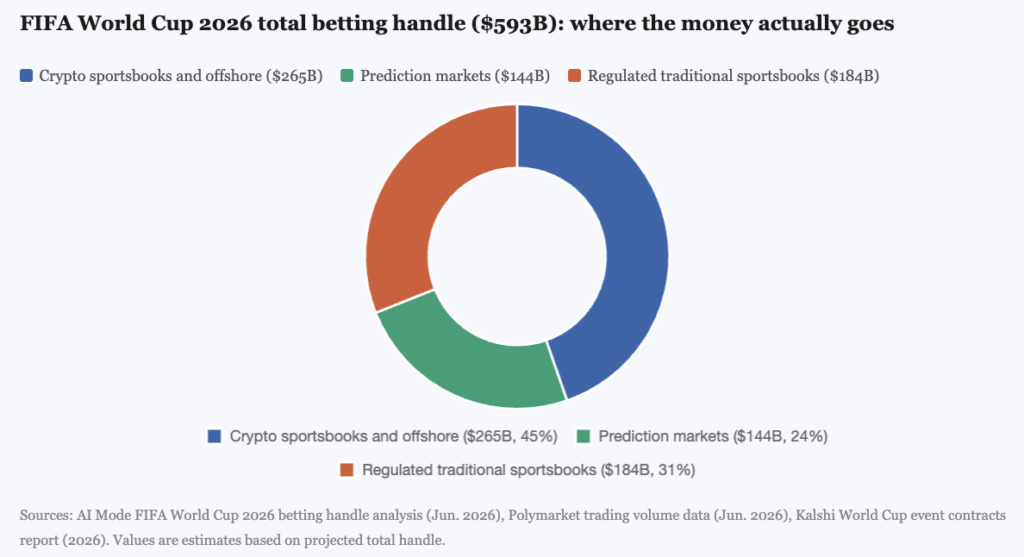
The total betting handle on this World Cup is $593 billion. The part that goes through traditional regulated sportsbooks is 31 percent. The rest goes somewhere else.
The number that keeps coming up in conversations about Bitcoin betting for the FIFA World Cup 2026 is $593 billion. That is the total projected wagering handle for the tournament, a figure that makes the $35 billion wagered during Qatar 2022 look like a rounding error. The jump is real, and the reasons behind it are not hard to find: 48 teams instead of 32, 104 matches instead of 64, prime time kick-offs for the Americas instead of the 2 am slots that Qatar imposed on half the planet, and three host nations that between them contain most of the world’s most active betting markets. But the more interesting number is not the total. It is the split. Of that $593 billion, regulated traditional sportsbooks like DraftKings, FanDuel, and their equivalents in Europe and Latin America capture about $184 billion, which accounts for 31 percent of the total. The other 69 percent, roughly $409 billion, is flowing through decentralized platforms, offshore crypto sportsbooks, peer-to-peer prediction markets, and payment rails that traditional finance does not touch.
That 69 percent is not a gap in the data. It is where the market actually went.
Why the majority of World Cup betting money bypasses traditional banking entirely
The short explanation is geography. DraftKings operates legally in about 26 US states. FanDuel covers similar territory. A fan in Argentina, Indonesia, Nigeria, or even a US state where sports betting is not yet regulated cannot use these platforms legally. The World Cup is a genuinely global event with a genuinely global betting audience, and the licensed, regulated market is not global. It is a patchwork of national and regional frameworks that leaves enormous gaps, and the people in those gaps did not stop wanting to bet. They found platforms that work across borders, and most of those platforms run on crypto.
This is the structural reason why Bitcoin betting for the FIFA World Cup 2026 has grown so quickly and why the growth is not simply a technology story. It is a market access story. Bitcoin and stablecoins like USDT are not geofenced by state borders or national payment regulations. A wallet in Jakarta, a wallet in São Paulo, and a wallet in Lagos all work the same way on the same blockchain, which means a crypto sportsbook can serve all three without needing a separate licence in each jurisdiction. That operational simplicity is worth a lot when the alternative is building a regulated product in 50 different markets simultaneously.
The data point that captures this most clearly is from a survey of US bettors conducted during the tournament: 83 percent said they want crypto deposit capability at their sportsbook. The demand is not coming from crypto enthusiasts. It is coming from sports fans who have decided that crypto payments work better for this specific use case than their bank does.
Prediction markets are now a serious part of this ecosystem
The most unexpected development in the FIFA World Cup 2026 betting landscape is not the growth of crypto sportsbooks. It is the scale to which prediction markets have grown. Polymarket’s standalone World Cup Winner contract approached $2 billion in total trading volume during the tournament. Total monthly turnover across the prediction market ecosystem topped $31.2 billion. In the United States, the CFTC-regulated platform Kalshi captured $2.9 billion in World Cup-specific trading volume, indicating that regulated American users were treating football match outcomes as a mainstream financial instrument alongside stocks and commodities.
This matters because prediction markets operate differently from sportsbooks, changing the relationship between the bettor and the platform. When you bet at a sportsbook, the platform is your counterparty, and the odds reflect the bookmaker’s view of probability plus their margin. When you trade on a prediction market, you are trading against other market participants, and the price is set by collective sentiment rather than by a house. Losses can be offset against wins for tax purposes in a way that traditional gambling winnings cannot in most jurisdictions, which is one reason financially literate bettors are shifting toward them. The World Cup is the event that pushed prediction markets from a niche tool used by election forecasters into something a normal sports fan has heard of and used.
What FIFA and its commercial partners did about all of this
The official response to the crypto betting boom was not to resist it but to join it at the top while managing the risks at the bottom. Kraken became FIFA’s first official crypto exchange partner for the 2026 tournament. FIFA integrated the Avalanche blockchain into its World Cup ticketing system via the FIFA Collect platform, partly to reduce ticket fraud and to establish a direct relationship with the blockchain infrastructure already handling a large share of fan transactions. Mastercard began deploying stablecoin-enabled settlement frameworks for merchant payments around tournament venues, which brought institutional finance into the same payment ecosystem that crypto sportsbooks were already using for player deposits and withdrawals.
At the same time, regulators in multiple markets issued warnings about the risks that come with the unregulated 69 percent. Lookalike phishing domains impersonating legitimate crypto sportsbooks. Fake World Cup meme tokens designed to collapse after initial hype—Non-KYC decentralized platforms with no consumer protection, capable of freezing assets or disappearing entirely. The volume flowing through alternative payment rails is real, and so are the bad actors trying to intercept it. The guidance from most regulators was consistent: if a platform has no verifiable licence, no published terms on withdrawals, and no way to contact support, the fact that it accepts Bitcoin does not make it trustworthy.
For fans who want to use FIFA World Cup 2026 Bitcoin betting platforms responsibly, the practical filter is the same one that applies to any financial platform: check the licence, read the withdrawal terms before depositing, and treat any platform that promises guaranteed returns or zero-risk betting as a warning sign rather than a feature. The $593 billion handle is real. The platforms worth using for your share of it are the ones that are transparent about how they work.