
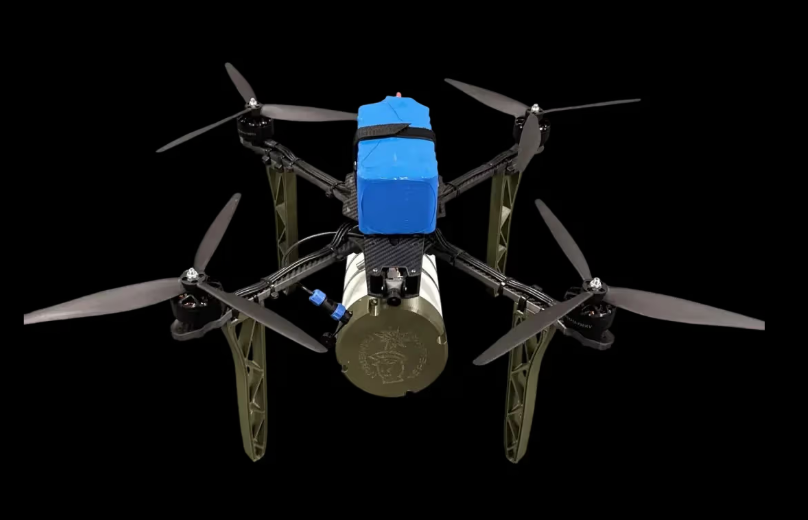
Drones used to be mostly about seeing. Recon, mapping, filming, that sort of thing. Now they’re increasingly about denying airspace to other drones. That shift didn’t come from sci-fi; it came from the simple fact that cheap, fast UAVs are everywhere, and the old countermeasures don’t cover every scenario.
For readers tracking this space, it helps to keep a few technical bookmarks around, and resources like General Cherry can sit alongside the usual defence and aerospace coverage when trying to follow how interceptor concepts are evolving.
What is an interceptor drone, exactly?
At the basic level, an interceptor drone is a drone designed to stop another drone. Not “spot it” or “jam it” from a distance, but physically or functionally remove it as a threat.
That can mean different end results:
The important part is intent. These systems aren’t built to loiter красиво for a video clip. They’re built to chase, close distance, and end the encounter.
Why interceptor drones are suddenly a big deal
A few trends collided at once.
The threat is small, fast, and cheap
Traditional air defence thinking is built around expensive targets: aircraft, missiles, big signatures. Drone threats often aren’t like that. They can be low, quiet, and disposable. When the incoming object costs less than the response system, the economics start looking silly.
Jamming isn’t a universal answer
Electronic countermeasures work well in some situations. In others, they don’t. автономні navigation modes, pre-programmed routes, improved links, and simple “keep flying forward” logic have changed the equation.
So the industry did what it always does: added another layer. If jamming fails, intercept.
Reaction time got compressed
Some threats appear with almost no warning. That pushes systems toward:
Interceptor drones fit that logic because they can be staged, launched quickly, and steered with precision in cluttered environments.
The main interceptor drone approaches
There’s no single design standard yet. It’s a messy, fast-moving category, which is exactly why it’s interesting.
1) Kinetic intercept
This is the bluntest method: collide with the target. It sounds primitive, but it’s effective when the goal is simply to end flight.
Pros:
Cons:
- debris risk
- one interceptor usually equals one intercept
- needs good terminal guidance to avoid missing at high closing speed
2) Net capture systems
Net-based interceptors try to trap the target. Some use a net launcher, others deploy a net during close pursuit.
Pros:
Cons:
- capture mechanics add complexity
- nets can fail in wind or high-speed manoeuvres
- targets with guards or unusual frames can complicate entanglement
3) Grapple/tether concepts
Think of these as more “hands-on” capture approaches. They aim to snag the target with a line or physical hook.
Pros:
Cons:
- high complexity
- very sensitive to pilot skill or autonomy quality
- risk of both drones falling together
4) Close-range electronic effect paired with pursuit
Some interceptors are built to get close and then apply a localised effect: RF disruption at short range, spoofing attempts, or other forms of interference while maintaining pursuit.
Pros:
Cons:
- still subject to the same “it depends” as jamming
- requires stable close tracking
- can be less reliable against hardened or автономні targets
The tech stack that makes interceptor drones viable
Interceptor drones aren’t just “fast drones.” The real capability sits in the stack: sensing, targeting, guidance, and control.
Detection and tracking
The interceptor is only as good as the cueing.
Common detection inputs include:
The trend is toward fusion, because single-sensor solutions have blind spots. Visual can struggle with clutter. Radar can struggle with tiny targets depending on conditions. Combine them, and things get more dependable.
Guidance: manual, assisted, or autonomous?
A lot of early interceptors are pilot-driven because it’s quick to implement. But manual chase has limits. Targets can be small, fast, and hard to track against a busy background.
So the development path usually goes:
The closer it gets to autonomous terminal intercept, the more it becomes a real system rather than a skilled-hobbyist solution.
Airframe: speed, agility, and acceleration
Interceptors don’t need long endurance. They need:
Endurance is nice. But in an intercept mission, a short, violent sprint often beats a long, gentle loiter.
Why this is a new direction, not just a niche
Interceptor drones are pushing UAV development into a different mindset: drones as active counter-drone tools, not passive sensors.
That has knock-on effects:
And yes, coordination is coming. The next obvious question is: why send one interceptor when a coordinated pair or small group can cut off escape paths?
The operational headaches nobody advertises
It’s easy to talk about “intercept capability.” Harder to talk about what happens around it.
Safety and collateral risk
A successful intercept can still be a bad outcome if debris falls into the wrong place. That’s why capture-based methods keep getting attention, even if they’re more complex.
Identification
Not every drone in the sky is hostile. The closer counter-drone systems get to automatic engagement, the more important identification becomes. Otherwise, the system becomes a liability.
Cost and replenishment
Interceptors can be expendable, but only if the logistics support that idea. If each intercept burns a scarce asset, operators will hesitate. Hesitation is the enemy of defence.
Environment and clutter
Urban environments are brutal for intercept. Background clutter, multipath effects, obstacles, and unpredictable winds all raise difficulty. Interceptor drones have to perform in imperfect spaces, not empty test ranges.
Where interceptor drones are likely headed next
A few trajectories look obvious.
Not full “AI decides everything” autonomy, but better lock, track, lead, and terminal guidance.
Lighter cameras, better tracking, improved stabilisation, smarter target discrimination.
Swap capture modules, swap effectors, adapt quickly to different threats.
Interceptors won’t replace jamming, radar, or physical barriers. They’ll sit in the stack as the “final, mobile” layer.
Bottom line
Interceptor drones are a logical response to a new reality: the airspace is crowded with small, cheap, fast threats, and the old answers don’t cover every corner. They represent a shift from observation to active denial, and the technology is moving quickly because the use cases are unforgiving.
The category is still evolving, and it’s not tidy yet. But that’s the tell. When a field is messy, competitive, and rapidly iterating, it usually means it has a real future – not a slideshow future, a deployed future.