
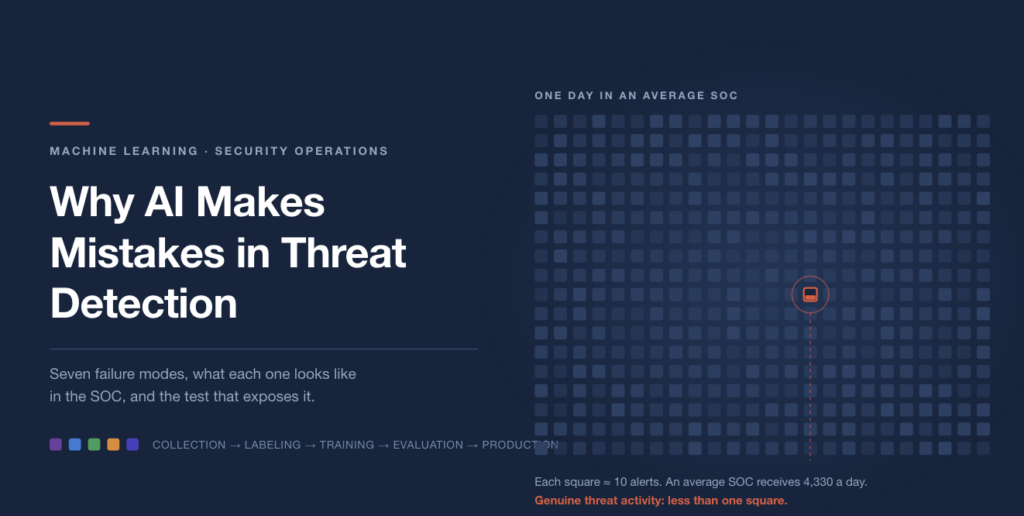
The causes are boring, which is exactly why they get missed. Skewed data, stale labels, leaky evaluation, and attackers who adapt faster than your retraining schedule.
Nearly all of it is catchable before rollout. This is why AI model testing should be treated as a dedicated stage rather than a final checkbox after training.
Below are seven failure modes in AI in threat detection, what each looks like on a real console, and the specific test that exposes it.
1. The base rate problem: why “99% accurate” means almost nothing
Malicious events are rare. On a mid-sized corporate network, you might process a million events a day and see a hundred that genuinely matter. That imbalance destroys the intuition most people bring from other ML work.
Run the numbers. A model that catches 99% of attacks with a 1% false positive rate flags 99 real threats and 9,999 harmless ones. Roughly 1 in 100 alerts is worth opening. Analysts learn that lesson in about a week and start closing the queue on autopilot.
What to do: stop reporting accuracy. Report precision at a fixed alert budget instead — “at 50 alerts per analyst per shift, we catch X% of attacks.” That single change reframes every conversation with the security team.
2. Training data that looks nothing like your network
Public intrusion datasets are convenient and often ancient. A model trained on synthetic traffic from a lab will meet your VPN concentrator, your legacy ERP box, and a marketing team that uses forty SaaS tools, and none of it resembles what it learned.
The tell is a model that performs beautifully in validation and then flags one specific subnet all day. Usually that subnet just has a traffic pattern the training set never contained.
What to do: before training, profile your production traffic and your training corpus on the same features — protocol mix, process ancestry, hours of activity, device types. Any feature where the two distributions clearly disagree is a future false positive factory. Fix it with real captured data, not more augmentation.
3. Labels that are wrong, late, or missing entirely
Your ground truth comes from tired humans closing tickets at 3 a.m. An analyst who marks a real intrusion “benign — no action” teaches the model that intrusion is normal. Do that a few hundred times and the model learns to ignore the exact behavior you hired it to find.
Missing labels hurt in a subtler way. Anything nobody investigated becomes an implicit “clean” example, so unnoticed attacks get baked in as normal.
What to do: have two analysts independently label a random sample of 300–500 events each quarter and measure agreement. If they disagree more than 10–15% of the time, your labeling guidelines are the problem, not the model. Also track how many “benign” closures were later reopened — that number is your label noise estimate.
4. Evaluation that leaks the future into the past
This one produces the most spectacular failures. Split five years of malware samples randomly into train and test, and your model sees 2024 samples while learning to classify 2021 ones. Reported accuracy goes up. Real-world accuracy does not.
Security ML researchers have documented this pattern repeatedly, along with related pitfalls like sampling bias and inappropriate baselines — the USENIX Security paper “Dos and Don’ts of Machine Learning in Computer Security” is the clearest catalogue of them and worth an afternoon.
What to do: split by time, always. Train on months 1–9, validate on month 10, test on months 11–12. Then check whether performance decays across those held-out months. A model that drops 15 points between month 11 and month 12 will drop further in production.
5. Shortcut features: when the model learns the wrong signal
Models take the cheapest path to a low loss. If every malware sample in your set was collected in a sandbox, the model may learn sandbox artifacts — an odd hostname, a specific screen resolution, a missing driver — instead of malicious behavior. It scores 98% and detects nothing real.
Other classics: a file path that only appears in your malware repository, a user-agent string unique to your collection tooling, or a timestamp range. One team found their model had essentially learned “files uploaded on Tuesdays are bad,” because that was their weekly ingestion day.
What to do: run feature attribution on your top-scoring detections and read them. If the top features are metadata rather than behavior, you have a shortcut. Then run an ablation: delete the suspicious feature and retrain. If performance barely moves, the feature is doing nothing. If it collapses, that feature was your model.
6. Drift: attackers change, models don’t
Networks change on their own. A new VPN vendor, a company-wide move to a different collaboration suite, an office opening in another time zone — each shifts the baseline your model calls “normal.”
Attacker behavior shifts too, and faster. Techniques get catalogued and adapted continuously; frameworks like MITRE ATT&CK are updated precisely because the technique inventory keeps moving. A model frozen at its training date is fighting last year’s playbook.
What to do: monitor the input distribution, not just output metrics. Track feature drift weekly with a simple population stability index or KS test, and alert when it crosses a threshold. Drift in inputs usually shows up weeks before precision visibly drops.
7. Adversaries who test your model harder than you do
Fraud analysts and malware authors probe defenses on purpose. They pad executables to change file size, break commands into pieces that look like ordinary admin work, add random delays so beaconing loses its rhythm, and lean on tools already installed on the host so nothing new gets written to disk.
Standard validation never sees these cases, because standard validation uses samples that were already caught.
What to do: build a small evasion suite — 20 to 50 modified versions of known-malicious samples — and run it on every model release. Padding, encoding, timing jitter, and renamed binaries are enough to start. Track “evasion rate” as a first-class metric next to precision and recall.
The seven failure modes at a glance
|
Failure mode |
What it looks like in the SOC |
Test that exposes it |
Fix |
|
Base rate blindness |
Thousands of alerts, almost none actionable |
Precision at a fixed alert budget |
Tune to alert capacity, not to accuracy |
|
Unrepresentative data |
One subnet or host type alerts constantly |
Distribution comparison, training vs production |
Retrain on captured in-house traffic |
|
Label noise |
Model repeats analysts’ known blind spots |
Two-analyst agreement on a random sample |
Rewrite labeling guidelines; re-label the sample |
|
Temporal leakage |
Great in testing, mediocre in week one |
Chronological split with month-by-month decay |
Time-based splits and periodic replay |
|
Shortcut features |
High scores on collection artifacts, misses real attacks |
Feature attribution plus ablation |
Drop metadata features; rebuild on behavior |
|
Drift |
Slow, quiet decline in catch rate |
Weekly input drift monitoring (PSI, KS) |
Scheduled retraining tied to drift thresholds |
|
Adversarial evasion |
Breaches found by other means, not the model |
Fixed evasion suite run at each release |
Adversarial samples added to training data |
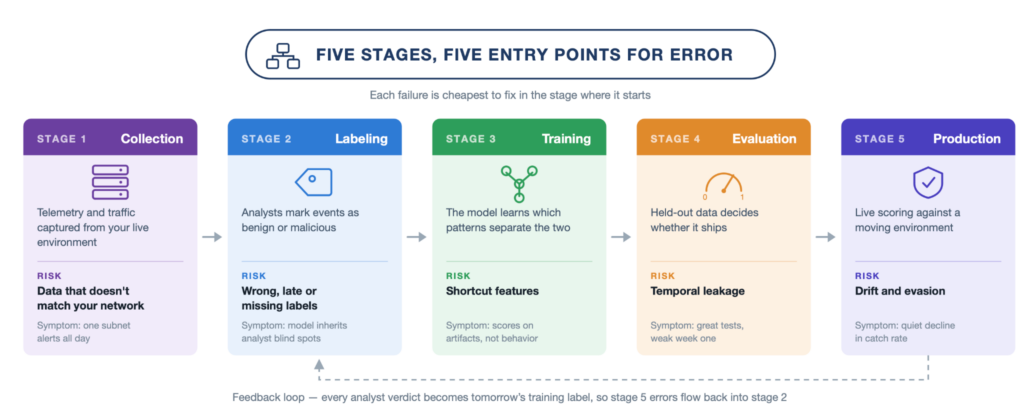
Where these failures actually enter the pipeline
 A pre-deployment checklist you can run this week
- Replace accuracy with precision-at-alert-budget in every report and dashboard.
- Compare feature distributions between your training set and last month of live traffic.
- Re-split all datasets chronologically and re-measure. Expect the number to drop.
- Have two analysts label the same 300 events; measure agreement.
- Read the top 20 features for your highest-confidence detections, by hand.
- Build a 20-sample evasion suite and record the baseline evasion rate.
- Set weekly drift monitoring on your five most important input features.
- Write down the retraining trigger — a drift threshold or a precision floor — before launch, not after.
Conclusion
AI in threat detection doesn’t fail because the algorithms are weak. It fails because rare events break ordinary metrics, because labels come from overloaded humans, because evaluation quietly cheats, and because the environment moves after the model stops learning.
None of those require a research breakthrough to address. They require testing that matches the problem: time-aware splits, honest precision numbers, label audits, drift monitors, and an evasion suite that gets a little meaner every quarter.
Pick two items from the checklist and run them before your next release. Most teams find something uncomfortable in the first afternoon — which is the whole point of looking.