

I. Introduction
Imagine you’re on a family vacation and your phone buzzes — it’s a smoke alert from your home. You check the app, see which room triggered it, and call a neighbor to investigate. No panic. No guessing. Just fast, informed action.
The stakes behind that scenario are real. Home fires claim roughly 2,600-2,900 lives in the US every year, and CO poisoning adds approximately 400 more, many in homes with no working alarm. WiFi-enabled combo alarms address both threats in one device, delivering remote alerts, dual-threat detection, and battery backup that keeps working even when the power goes out.
This guide walks you through what to look for, how leading models compare, and how to get the most out of your alarm long-term.
II. Why Smart Combo Smoke + CO Alarms Are Important for US Homes
Carbon monoxide is often called the “silent killer” — and for good reason. It is colorless, odorless, and tasteless. By the time symptoms appear (headache, dizziness, nausea), a person may already be too impaired to evacuate safely. Common household sources include gas furnaces, water heaters, fireplaces, attached garages, and portable generators.
US building codes are increasingly strict on this front. Many states now require CO alarms in all homes with attached garages or fossil-fuel-burning appliances. Some jurisdictions mandate combo units near sleeping areas. Check your local code — non-compliance can affect your homeowner’s insurance and resale value.
A WiFi smoke and carbon monoxide alarm addresses both threats in a single device. That means fewer units to install, fewer batteries to track, and simpler testing routines. Add WiFi functionality, and you gain:
- Instant smartphone alerts, even when you’re not home
- Integration with smart home platforms like Alexa, Google Home, or Apple HomeKit
- A connected alarm system that can trigger other smart devices (lights, locks, thermostats)
- Alarm history logs accessible through an app
For busy families, renters, and anyone who travels frequently, that added layer of awareness is genuinely valuable.
III. 5 Key Factors American Families Should Consider
1. UL Certification — The Most Important Factor
Start here. The Underwriters Laboratories (UL) mark is not a marketing claim — it is a third-party safety certification based on rigorous testing protocols. For smoke alarms, look for UL 217. For CO alarms, look for UL 2034. A combo unit should carry both.
UL certification means the smoke and carbon monoxide alarm has been independently tested for detection accuracy, false alarm resistance, and durability. Without it, you have no assurance the product will perform when your family’s safety depends on it. Never compromise on this.
2. Sensor Technology — Photoelectric + Electrochemical
Not all sensors are equal. There are two main smoke detection technologies:
- Photoelectric sensors: Better at detecting slow, smoldering fires that produce large smoke particles — the type most common in residential bedrooms.
- Ionization sensors: Faster at detecting fast-flaming fires, but more prone to nuisance alarms from cooking.
The best WiFi smoke and carbon monoxide alarms use photoelectric technology for smoke. For CO, they use an electrochemical cell sensor — the gold standard for accurate, stable detection. This pairing gives you broad-spectrum protection with fewer false alarms.
3. Power Supply & Battery Performance
Your WiFi smoke and carbon monoxide alarm is only useful if it’s powered. Options include:
- Hardwired with battery backup: Most reliable, but requires professional installation.
- Battery-only: Easier to place anywhere, but requires diligent battery management.
If you choose a battery-powered model, look for a large-capacity battery (1,000 mAh or more) and a low standby current draw (under 15 microamps). Together, these translate to longer real-world battery life. Low-battery warnings should trigger well in advance — ideally 30 days before failure.
4. Alarm Loudness and Performance
The NFPA recommends alarms produce at least 85 dB at 10 feet. However, for homes with children, elderly residents, or heavy sleepers, louder is better. Look for models rated at 90 dB or above.
A loud smoke and carbon monoxide alarm is especially critical at night, when a sleeping person may be slow to respond. Some models also include voice alerts that announce the specific hazard (“Fire!” vs. “Carbon monoxide!”), reducing confusion during an emergency.
5. Smart Features and App Experience
WiFi connectivity is only as good as the app behind it. Before buying, check:
- Is the app well-rated on both iOS and Android?
- Does it support real-time push notifications?
- Can you view alarm history and device status remotely?
- Does it integrate with your existing smart home ecosystem?
Some apps also support multi-device management — useful if you’re protecting a larger home with WiFi smoke and carbon monoxide alarms on every floor. Setup should be straightforward. If an app requires extensive troubleshooting just to connect, that’s a warning sign for long-term reliability.
IV. How Different Models Compare in the Market
The US market for WiFi smoke and carbon monoxide alarms breaks into two main categories. Each suits a different type of buyer.
Established Mainstream Brands (e.g., Kidde, First Alert)
Kidde and First Alert dominate the US residential safety market, together accounting for the majority of alarms sold through retail channels. Both brands offer a full product range — from basic wired combo units ($40–$70) to advanced WiFi-enabled and whole-home interconnect systems.
For households prioritizing whole-home coverage, both brands support interconnect technology — when one alarm triggers, all linked units sound simultaneously. Kidde has expanded this through its Wire-Free Interconnect line and a partnership with Ring; First Alert’s OneLink series integrates with Alexa and Apple HomeKit. The main trade-off at the entry level is that basic models remain standalone with limited app support, so buyers need to select the right tier within each product line.
WiFi-Enabled Smart Brands (e.g., GasDog)
This tier combines full UL certification with WiFi connectivity and app-based monitoring. Prices generally fall between $70 and $120 across brands.
GasDog is a newer entrant with less brand recognition, but its GD1000-S12 holds both UL 217 and UL 2034 certification and connects through the Smart Life platform, supporting both Alexa and Google Assistant. It is a practical option for buyers who want certified WiFi functionality without committing to a premium price. The trade-off is a less polished app experience compared to first-party platforms.
Neither brand is the obvious winner for every household. The better choice depends on your existing smart home setup and how much weight you put on brand familiarity versus feature flexibility.
Quick Comparison
|
Model |
UL Cert. |
Alarm |
WiFi / App |
Power Type |
|
Kidde Smart / Ring |
UL 217 + 2034 |
85-90 dB |
Ring App + Alexa |
Hardwired / Battery |
|
First Alert OneLink |
UL 217 + 2034 |
85 dB |
Alexa + Apple HomeKit |
Hardwired / Battery |
|
GasDog GD1000-S12 |
UL 217 + 2034 |
90+ dB |
Smart Life (Tuya) |
Battery Powered |
V. Installation and Maintenance Best Practices
Placement
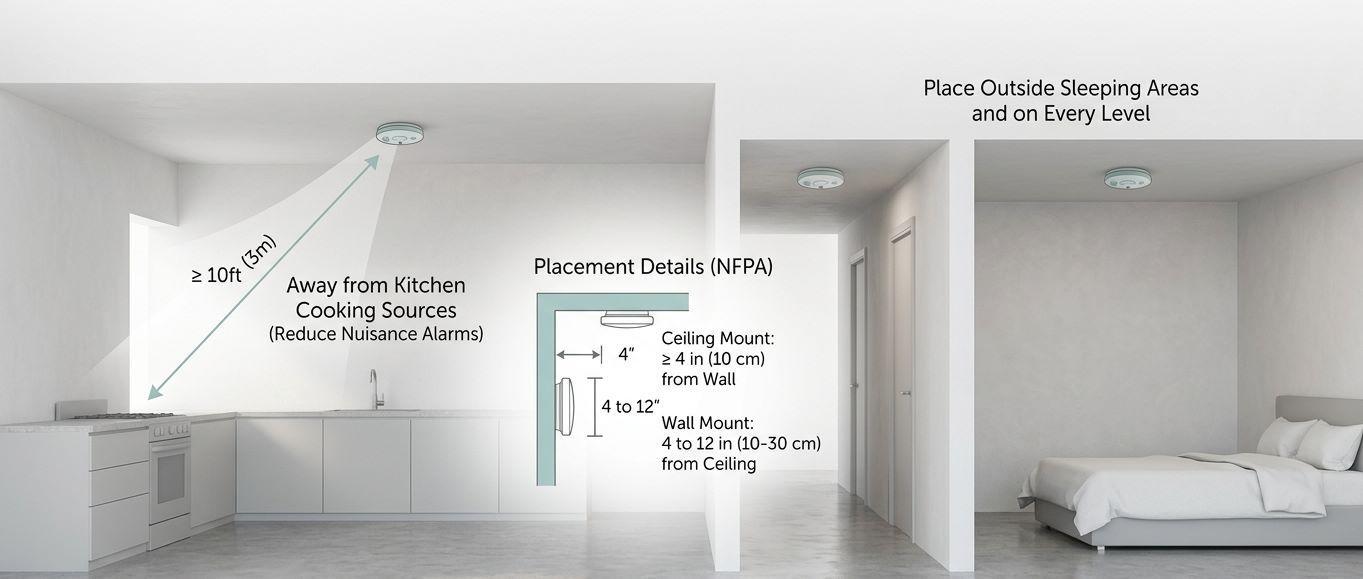
The NFPA recommends installing smoke alarms on every level of your home, inside each bedroom, and outside sleeping areas. CO alarms should be placed near sleeping areas and on each floor. Mount ceiling units at least 4 inches from the nearest wall. For wall mounting, position between 4 and 12 inches from the ceiling.
Avoid placing smoke and carbon monoxide alarms near kitchens, bathrooms, or garages without adequate ventilation — these locations generate steam, exhaust, and cooking smoke that can trigger nuisance alarms.
Reducing False Alarms
- Use the hush/silence feature (if available) for cooking-related false alarms.
- Ensure the unit is at least 10 feet from cooking appliances.
- Keep the sensor grille free of dust and insect debris.
Replacement Guidelines
Smoke alarms should be replaced every 10 years. CO alarms typically have a 5–7 year lifespan due to sensor degradation. Check the manufacture date printed on the back of your unit. If it’s expired, replace it regardless of whether it still beeps during a test.
VI. Conclusion
Choosing the right smoke and CO alarm comes down to a clear priority order: certification first, then features.
A WiFi smoke and carbon monoxide alarm is no longer a luxury — it’s a practical upgrade that gives any family faster awareness and better peace of mind, whether you’re asleep in the next room or thousands of miles away.